Supply Chain & Procurement
DNOW operates a distribution network of approximately 300 locations in more than 20 countries, sourcing from thousands of vendors to serve customers in the energy and industrial sectors. As a distributor, our largest environmental impacts sit upstream and in transportation. To manage these impacts, we focus on three levers: how we qualify the manufacturers we work with, how we set supplier expectations and how efficiently product moves.
Supply Chain Performance Snapshot
The information below highlights key supply chain, procurement, quality and supplier-related human rights disclosures from DNOW's 2025 Sustainability Report: Stronger Together. For complete details and reporting methodologies, please review the full report.

Supplier Qualifications
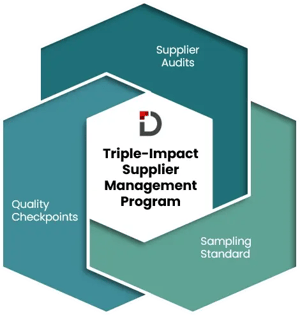
DNOW evaluates and qualifies key pipe, valves and fittings (PVF) suppliers through the Triple Impact Supplier Management Program (TISMP),1 structured around three stages: supplier onboarding, in-process quality control and continuous performance monitoring.
During onboarding, suppliers are assessed on product quality; health, safety and environmental standards; labor and human rights; legal compliance; and social responsibility, supported by rotating on-site audits of key manufacturing facilities. Qualified suppliers are added to the Approved Manufacturers List (AML) with Preferred or Approved status, directly informing sourcing decisions.
|
In 2025, DNOW conducted 65 on-site supplier audits.2 These evaluations go beyond product conformance to assess suppliers' environmental, labor, legal and social practices. |
Ongoing oversight includes inbound product inspections using ISO 2859 sampling plans; review of quality, health, safety and environmental performance; quarterly physical and chemical testing; and material traceability through DNOW's MetalTrace database, which links distributed products to mill-level material test reports.
1 A key supplier is defined as a PVF product provider with whom DNOW maintains a long-term relationship, preferential business status and an established track record of quality.
2 Across its two legacy supplier qualification programs. Legacy DNOW completed 15 audits; legacy MRC Global completed 50 audits.
DNOW's IMPACT Quality Goals
Increase employee capabilities
Maintain accurate inventory
Provide quality products & services
Always deliver on-time
Continually improve
Total customer satisfaction
Responsible Supply Chain
Qualification determines DNOW’s supplier partners. The Company’s Responsible Supply Chain standards govern how those suppliers, and everyone else the Company does business with, are expected to operate.
Supplier Code of Conduct
DNOW’s Supplier Code covers labor and human rights, workplace health and safety, anti-corruption, trade compliance, environmental responsibility and ethical business practices, and expressly prohibits forced labor, child labor, discrimination and harassment.
It draws on internationally recognized standards, including the International Bill of Human Rights, the ILO Declaration on Fundamental Principles and Rights at Work, the OECD Guidelines for Multinational Enterprises, the UN Guiding Principles on Business and Human Rights and the Ten Principles of the UN Global Compact.
Suppliers and their personnel can report suspected violations through the Governance Hotline (see page 15). DNOW maintains a strict policy against knowingly purchasing products manufactured in violation of environmental laws and regulations.
Conflict Minerals
DNOW maintains a conflict minerals program designed to support compliance with applicable regulatory requirements, including the Dodd-Frank Act and related SEC disclosure obligations.
As a distributor, DNOW does not directly source raw materials and is several tiers removed from mines, smelters and refiners. The Company expects suppliers and manufacturers to conduct due diligence so that tin, tantalum, tungsten and gold in distributed products do not directly or indirectly finance armed groups operating in the Democratic Republic of the Congo or adjoining countries.
Supplier Diversity
DNOW's Supplier Diversity program engages certified manufacturers, suppliers and service providers that are majority-owned and operated by women, veterans and members of underrepresented groups, as well as small businesses, and incorporates these considerations into sourcing and procurement.
| Human Rights Disclosures |
|---|
|
DNOW publishes annual human rights disclosures under the UK Modern Slavery Act, Canada’s Supply Chains Act and the Norwegian Transparency Act. Each describes the steps taken to identify and address forced labor and human rights risk in DNOW's operations and supply chain. These disclosures are supported by human rights due diligence, the Company's Human Rights Policy and its Forced Labor Statement and are available on the Company's website. |
Sustainable Distribution & Fulfillment
DNOW has a highly agile warehouse and logistics model that gives it the flexibility to optimize safety stocks across its network. Regional distribution centers and super centers support the branch network through a hybrid approach: fulfilling project orders, restocking select products and positioning inventory where demand warrants. The network expands where customer demand justifies it and consolidates where it does not.
Customers benefit from this efficiency: instead of managing deliveries from thousands of suppliers, they receive combined shipments from a single point of contact, reducing site traffic, fuel consumption and administrative overhead.
Where logistics allow, products ship directly from manufacturers to end customers, bypassing DNOW facilities entirely. Domestic freight moves in consolidated weekly or bi-weekly loads rather than smaller, more frequent shipments, and combining same-day orders into single loads is under evaluation in select lanes. Parcels, a small share of total freight, move through the carrier carbon-neutral program described on page 29.
Efficiency extends beyond the network to how customers order and how goods are packed.

Fewer deliveries, planned earlier
Supply chain teams engage customer procurement departments early in project planning to combine shipments and reduce the number of individual deliveries. Digital ordering through DigitalNOW® and MRCGO™ routes more volume through Super Center fulfillment and supports direct delivery to customer sites.

Less packaging, less waste
Facilities recycle and reuse cardboard, plastic and wood packaging materials, and scrap metal is recycled. Industrial compacters reduce waste volume and hauling trips, and water refill stations cut single-use plastics. Water and waste data are detailed on page 28.